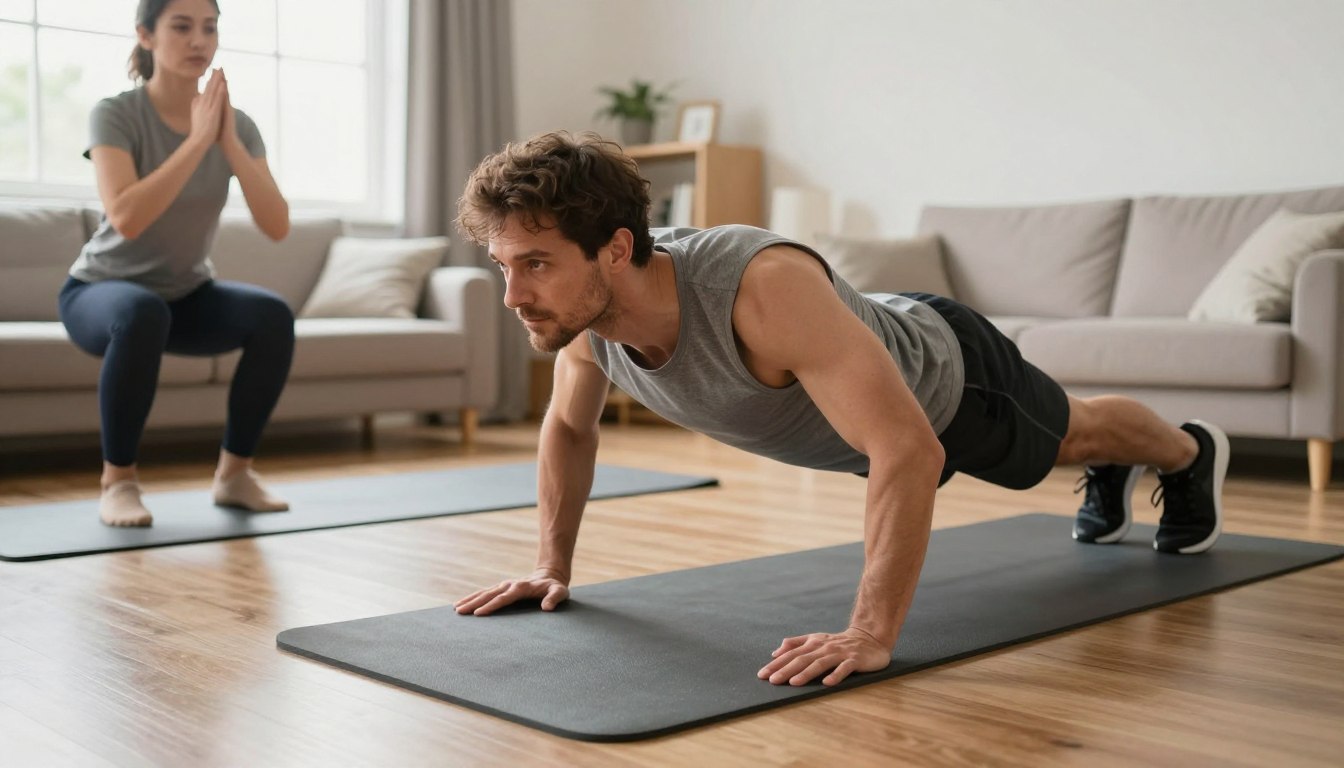
Ready to prove that you can get stronger without a gym? This guide shows how simple bodyweight exercises and workouts build real strength, movement, and stamina in a living room, garage, or hotel room. These effective workouts demonstrate that you can achieve your fitness goals at home.
What this means: you’ll learn clear movement patterns, form cues, and plug-and-play workout routines that scale from beginner to advanced. Expect focused sessions for upper push, squats and lunges, core stability, pull alternatives, and short finishers that raise your heart rate during your strength training exercises.
Think of this as a practical how-to, not hype. You’ll learn progressions, warm-up priorities, and ways to track gains week to week. If your schedule is tight, you travel often, or the gym is closed, these bodyweight workouts keep your strength and agility steady.
Safety first: modifications are included if your knees or shoulders flare up, and the plan favors repeatable consistency over risky maximums. Use proper form, start slow, and build reliably with these exercises.
Key Takeaways
- Bodyweight training builds strength, conditioning, and mobility.
- The guide gives scalable routines from beginner to advanced.
- Focus on form, warm-up, and weekly progressions.
- Sections cover pushing, squats/lunges, core, pulls, and finishers.
- Safe modifications help if knees or shoulders are sensitive.
Why bodyweight training works for strength, muscle, and fitness at home
You can get stronger and more athletic by mastering bodyweight movement patterns. Using your body as the load lets you progress gradually and measure real gains. This approach builds strength and can stimulate muscle growth when you increase total work over time.
How compound movements train multiple muscle groups
Compound moves like lunges, pushups, burpees, jump squats, and mountain climbers are your best time-savers. They recruit multiple muscle groups at once and pair strength with cardio when done in circuits.
Why managing your own weight builds athleticism beyond machines
Controlling your torso, ribs, hips, and shoulder blades teaches balance, coordination, and durability. This kind of training develops movement quality that a typical gym machine often misses.
What “intensity” looks like without extra weight
Intensity comes from levers you control: faster pace, tougher variations, more reps, less rest, longer time under tension, and tighter full-body tension. Think in patterns—push, squat/lunge, core, pull, and carry-like bracing—so your programming stays simple and effective.
Progressive overload still applies: increase work over weeks, tighten form, and add harder variations. Hard doesn’t need heavy to work.
What you need before you start: space, surfaces, and simple household supports
Before you start, clear a safe area so your movement isn’t limited by furniture or slick floors. A little prep saves injury and wasted minutes when you train. The goal is a predictable zone where you can plank, lunge, and move without interruption.
Choosing a flat floor and creating a safe workout zone
Pick a flat floor with enough clearance to kick your legs back for burpees without clipping furniture. Check rugs and slippery patches and remove anything that can trip you.
Identify three surface types: a non-slip spot for jumps, a softer area (or mat) for planks and core work, and a clear wall space for wall sits.
When a chair, wall, or sturdy table can help (optional support)
Use a chair for triceps dips or step-ups, and a sturdy table edge for inverted rows only if it doesn’t wobble. Test the starting position for floor moves: check hand placement, wrist comfort, and that shoulders feel stacked and stable.
- Confirm your starting position before a set.
- Keep a mat handy to cushion knees and forearms, though it’s optional.
- Set a simple timer so short sessions measured in minutes run smoothly without delay.
Warm-up and mobility: get your heart rate up in about five minutes
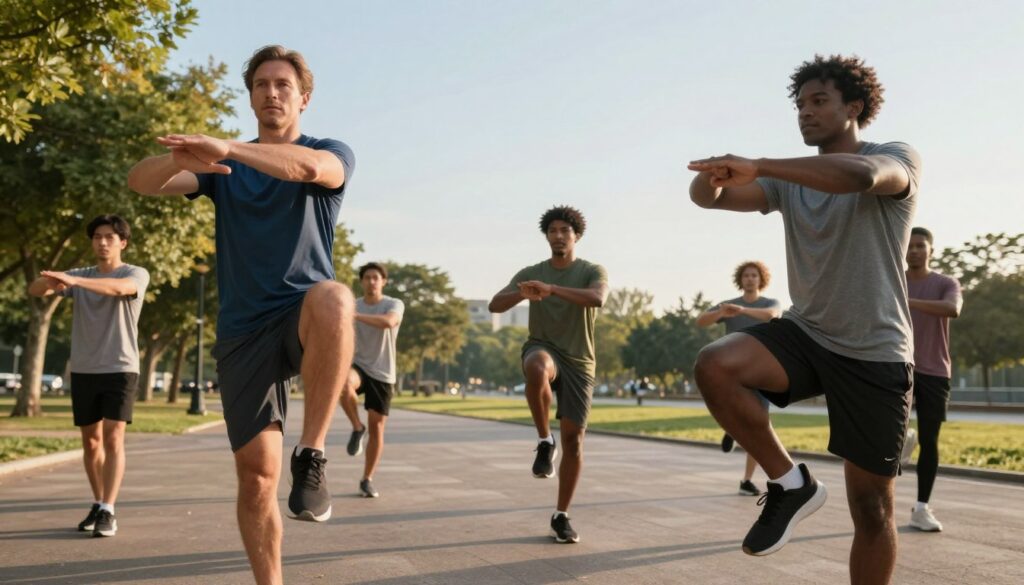
Kick things off with quick, low-risk moves that prepare your body in about five minutes. This short warm-up raises circulation and helps joints feel ready before you add intensity.
Quick warm-up moves you can do in place
Start with marching or high steps and jumping jacks to lift pulse and loosen hips.
Follow with light jogging in place or brisk step-outs for 30–60 seconds.
Do a few slow bodyweight squats and hands-on knees lunges to groove lower-limb patterns.

How to prep your hips, knees, shoulders, and back for training
Mobilize ankles and hips with gentle leg swings and hip openers so depth feels controlled.
Protect your knees by starting with small bends, then go deeper when movement feels smooth.
Prep shoulders with controlled plank holds and slow push-up reps so pressing feels stable.
Brace your core and practice a neutral spine to keep your back safe during plank-based work.
- Short routine idea: 30s high steps, 20s squats, 20s slow push-ups, 30s leg swings.
- Tip: Move deliberately—speed up only when joints and breathing match the pace.
Form checkpoints that protect your knees, back, and shoulders
A few simple position cues go a long way toward safe, effective training. Locking in a repeatable start position keeps each rep consistent and lets you track progress without adding risk.
Starting position basics for planks, squats, and pushups
Set a consistent starting position so every rep looks the same. For pushups and plank holds, place hands under shoulders and keep your head neutral.
Pushup cues: full-body tension, a straight spine, elbows about 45 degrees, and a controlled descent and press.

How to keep your torso stable and core engaged
Brace your core and squeeze glutes to create a straight line from shoulders to heels. This stabilizes the back and improves force transfer in all movements.
Make sure you breathe steadily while holding tension—don’t let the ribs flare or the hips sag.
Common mistakes that cause knee pain during lunges and squats
Spot knee pain triggers early: collapsing arches, knees caving inward, stepping too narrow, or dropping too fast into the bottom.
Use “quiet reps”: scale any move where your knees slam or your hips sag immediately.
- Hands stacked under shoulders for pushups and plank.
- Sit hips back in a squat while keeping chest proud.
- Keep lunges controlled; load the forward glute, not the knee.
“Form first. Progress follows.”
home workouts no equipment for men: the foundational movement patterns to train
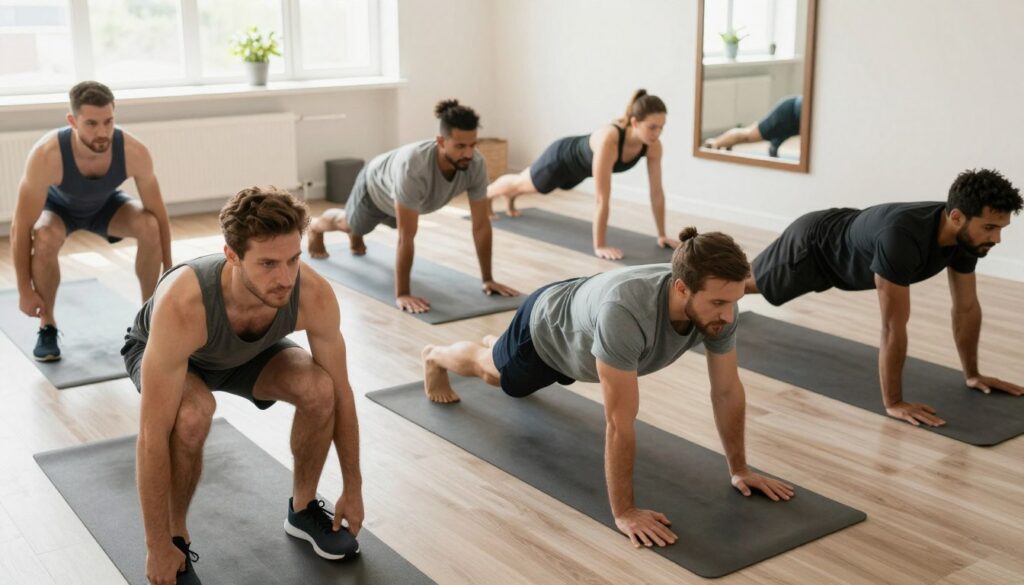
Focus on a small set of movement patterns and you’ll get steadier gains every week. Organizing your week by patterns makes the home workout plan repeatable and measurable.
Push pattern — Pushups and their variations target chest, shoulders, and arms by changing leverage and hand placement. Start with standard exercise reps, then shift to incline or decline to increase challenge.
Squat and lunge patterns — Air squats, split squats, and reverse lunges train your leg muscles and glutes. These bodyweight exercises also test balance and single-leg stability, which improves real-world strength.
Core stability — Hollow holds, mountain climbers, and bird dogs build a transferable brace. A stronger core improves pressing and squatting and cuts injury risk, making it essential for effective strength training.
Pull options — Be creative: inverted rows under a sturdy table, a backyard branch, or a fixed bar mimic pulling and help shoulder health. These bodyweight exercises keep your physique balanced and are great for your overall workout routine.
- Train by patterns to ease progression and recovery.
- Cover push, squat/lunge, core, and pull each week.
- Frame this as consistent strength training, not just sweating.
“Patterns make progress measurable and sustainable.”
Upper-body staples: pushup variations for chest, shoulders, and arms
Build your upper strength by mastering a few push exercises that scale cleanly for your home workout. Start with a reliable baseline, then add variations that target different muscles and movement demands.
Standard pushup — Set in a high plank with hands under shoulders. Keep full-body tension, elbows about 45°, and stop when your chest is roughly one inch from the floor. Aim for 3 sets of 12–15 reps as your baseline strength and muscle builder for effective exercise.
Close-grip press for triceps focus
Place hands just narrower than shoulder width to shift load to the triceps and inner chest. Keep elbows from flaring and control each rep. Try 3 sets of 10–12 reps to develop stronger arms and pressing control.
Shoulder and core challenge
Dolphin pushups add shoulder and core demand without gear. Use them in circuits as a tougher variation, not a sloppy substitute. They improve overhead stability and midline strength.
Progressions when standard reps stop working
When 12–15 reps feels easy, follow this order: add reps, slow the tempo, elevate feet, then move to archer or assisted one-arm progressions. These rules keep your bodyweight stimulus moving upward.
| Variation | Sets | Reps | Main focus |
|---|---|---|---|
| Standard pushup | 3 | 12–15 | Chest, shoulders, core |
| Close-grip pushup | 3 | 10–12 | Triceps, inner chest |
| Dolphin pushup | 2–3 | 8–12 | Shoulders, core |
| Advanced progressions | 2–4 | 6–12 | Strength and skill |

“Dial in your starting position, then let intention and tempo drive progress.”
Lower-body builders: legs, glutes, and power without weights
A focused lower-body block delivers strength, stability, and short bursts of power you can repeat weekly.
Air squats and squat pulses
Start with air squats to build solid movement. Focus on consistent depth and a controlled tempo before you add speed.
Tip: Use squat pulses to increase time under tension and train the posterior chain without extra load.
Walking and reverse lunges
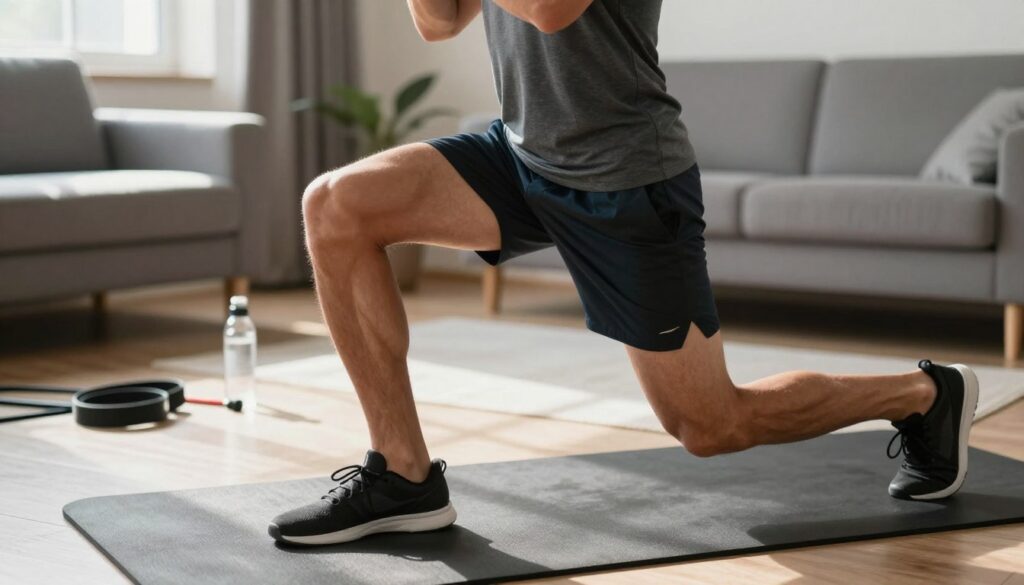
Do walking lunges or reverse lunges for single-leg strength and balance. Aim for 3 sets of 8–10 reps per leg or 45s on/15s off for five minutes.
Keep an upright chest and engage glutes to protect the knee joint.
Power options and wall sit
Add jump squats (30s on/30s off) to train explosive power as part of your home workout routine. Substitute low-impact fast squats if impact irritates your knees during these exercises.
Include a wall sit for 1-minute holds to build quad endurance and increase times under tension in your workout.
- Track progress by more reps, longer holds, or less rest.
- Scale impact by removing jumps, shortening range, or slowing eccentrics.
| Move | Sets | Work | Main focus |
|---|---|---|---|
| Air squat | 3 | 12–15 | Leg strength, form |
| Walking lunge | 3 | 8–10 per leg | Balance, unilateral stability |
| Jump squat | 2–4 | 30s work / 30s rest | Power, explosiveness |
| Wall sit | 2 | 60s hold | Quad endurance, tension times |
“Build strength with steady progress, not sudden jumps.”
Core moves that transfer to everything you do
Your core is the control center that ties leg drive to upper-body force. Train it with intent and you’ll see carryover to pressing, squatting, and sprinting.
Plank holds and side options for total-core stability
Plank holds teach full-body tension. Use steady breathing and keep a straight line from head to heels.
Rotate into a side plank to stress lateral stability and shoulder control. Hold each side for quality over time.
Hollow hold as the next-level trunk challenge
Drive your low back into the floor, lift feet about two inches, keep shoulder blades up and arms overhead.
Do 3–4 sets of 45–60 seconds. This flattens the back and forces tight ribs and deeper muscle recruitment.
Mountain climbers for abs plus cardio
Use 6 minutes of 20s on / 10s off. Keep hips level and shoulders stacked so the core, not momentum, does the work.
Bird dog for control, posture, and back-friendly core work
Start wrists under shoulders and knees under hips with a neutral spine. Do 3 sets of 8–10 slow reps with pauses.
This trains anti-rotation and helps protect your back while improving posture.
Hard-core progression options when you’re ready
Advance only after you master basics: longer hollow levers, plank reaches, and controlled flutter variations demand clean form first.
| Move | Protocol | Main benefit |
|---|---|---|
| Plank / Side plank | 3 sets, 30–60s | Total tension, lateral stability |
| Hollow hold | 3–4 sets, 45–60s | Anterior core strength, low back contact |
| Mountain climbers | 6 min, 20s on/10s off | Core endurance + cardio |
| Bird dog | 3 sets, 8–10 reps | Control, posture, back-friendly stability |

“Brace well. The core is the engine that powers every other move.”
Conditioning finishers: fast ways to spike your heart rate
Use short finishers to add a controlled conditioning boost at the end of your home workout session. They raise intensity without turning a quick exercise session into an all-day grind.
Burpees are the go-to finisher. Do 2–4 rounds of 40 seconds on, 20 seconds off. Move through a squat → plank → controlled pushup → step or jump forward → jump up. Focus on clean positions more than raw speed.
You can scale burpees to lower impact by stepping back instead of kicking, and by removing the jump at the top. Keep the tempo steady so each rep stays crisp.
Jump lunges and high knees
Use jump lunges and high knees when you want short bursts. Do them in seconds-based intervals to force quick cardiovascular work without long runs.
- Finishers live at the end of a workout to drive conditioning efficiently.
- Stop a set before form breaks; repeat another round when you move well again.
- Track progress by tightening work-to-rest or adding rounds, not by endless all-out effort.
“Short, smart finishers beat sloppy, long efforts every time.”
How to build your no-equipment routine using circuits, intervals, and AMRAP
Build a simple session template that fits your time and raises both strength and heart rate. Pick five to eight compound moves and arrange them so you hit push, legs, core, and a pull option when possible.
Circuit training format: reps, minimal rest, full-body effect
Run the moves back-to-back with tight transitions. Use reps or short timed sets and keep 15–30 seconds of rest between stations to keep the heart rate up and preserve form.
HIIT timing ideas using seconds on and seconds off
Set simple intervals like 30 seconds on / 10 seconds off or 40 seconds on / 20 seconds off. These seconds-based formats control intensity and make pacing easy.
AMRAP structure for measurable effort in minutes
Use AMRAP blocks such as 12 or 20 minutes where you do as many quality rounds as possible. Record rounds and reps so your next session is comparable.
How to choose work-to-rest ratios based on your fitness level
If form breaks, lengthen rest. If you stay crisp, shorten rest and add rounds. Balance sets by pairing a push with a leg and a core move so recovery and progress remain steady.
“Short, timed blocks reveal progress faster than guessing effort.”
Progressive overload without weights: how you keep getting stronger
Progressive overload still applies when you only use bodyweight. You just change the variables around the movement instead of adding plates.
Increase reps and total rounds over time
Start by adding a few extra reps each set. Track total rounds per session so weekly volume climbs in a clear, measurable way.
Decrease rest times to raise intensity
Trim rest between sets slowly. Shorter rest forces your heart and muscles to adapt without changing the move.
Increase time under tension by slowing movements
Slow the lowering phase, add pauses, or use tempo reps. Making a rep last longer increases stress without extra weight.
Add tougher variations when you hit a plateau
When reps and rounds stall, shift to harder progressions—deeper squats, advanced push styles, or longer holds.
When it’s smart to push close to failure
Occasionally push safe, stable moves near failure to spark gains. Avoid going to failure on fast or technical drills.
- Checklist: increase reps → add rounds → reduce rest → slow tempo → change variation.
- Use this order so changes are predictable and trackable.
| Variable | How to change | Effect |
|---|---|---|
| Reps | +2–5 per set | Builds muscle and work capacity |
| Rest | -5–15s | Raises intensity |
| Tempo | Slower eccentrics, pauses | More time under tension |
Done-for-you workouts you can follow today
These done-for-you sessions remove guesswork so you hit purpose-driven reps every time.
Beginner full-body circuit
20-minute sample: air squats 20, walking lunges 10 per leg, push-ups 10, plank 30s, jumping jacks 30s. Repeat the circuit 3–4 times with 30–45s rest between rounds.
Intermediate full-body routine
Higher volume legs and push work: air squats 20, walking lunges 20 per leg, box jumps 20, push-ups 20, pistol squat progressions 10 per side, chair triceps dips 10, plank 1 minute. Repeat 3 rounds or more as you build capacity.
Low‑equipment chair circuit
Use a stable chair for triceps dips and step-ups. Sample circuit: push-ups 15, triceps dips 15, plank 45s, jump lunges 20. Keep shoulders packed and stop any move that hurts.
Core burner circuit
Quick midsection hit: plank 1 minute, hollow hold 30s, mountain climbers 30s, side plank 30s per side. Repeat 3 rounds for stability and conditioning.
Back‑focused mini session
Protect balance with pulling work: inverted bodyweight row 3 sets of 8–10 reps using a bar or sturdy table. Follow with bird dog 3×10 to reinforce posture.
| Session | Rounds | Key moves |
|---|---|---|
| Beginner circuit | 3–4 | Air squats, lunges, push-ups, plank, jumping jacks |
| Intermediate circuit | 3+ | Box jumps, pistol progressions, higher push volume, longer plank |
| Chair option | 3 | Triceps dips, step-ups, push-ups, planks |
| Core burner | 3 | Plank, hollow hold, mountain climbers, side plank |
| Back focus | 3 | Inverted rows, bird dog, face-pulls substitute |
How many circuits to do: start with 3 rounds and add one round when you can keep form for every rep.
“Start simple. Track rounds and reps so progress is measurable.”
Time-efficient schedules for busy weeks
When minutes are tight, prioritize quality over length and choose moves that tax the whole body.
The 7-minute scientific-style circuit when you’re short on time
Use this as your minimum effective dose on the busiest days. Move through each station with tight transitions and steady form so you don’t turn a quick session into sloppy cardio.
- Jumping jacks (30s)
- Wall sit (30s)
- Push ups (30s)
- Abdominal crunch (30s)
- Step-up onto chair (30s)
- Air squats (30s)
- Triceps dips on chair (30s)
- Plank (30s)
- High knees running in place (30s)
- Lunge (30s)
- Push-ups with rotation (30s)
- Side plank (30s)
Run it clean once when you only have a few minutes. Focus on consistent tempo and full range of motion.
20-minute sessions for strength plus cardio
Build a 20-minute block by pairing one push, one leg move, a core hold, and a short finisher. Use short rests (10 seconds) and repeat the circuit 3–4 times.
This format blends strength and conditioning so each workout feels purposeful, not frantic.
How many times per week you should train for results
Aim for 3–5 training days depending on recovery and schedule. Pick a layout you can repeat across weeks rather than chase a perfect plan.
Include at least one easier day for mobility or walking and track the same routine for several weeks to measure progress in rounds, reps, and perceived exertion.
“Short, consistent sessions compound into real progress over time.”
Recovery, consistency, and staying injury-free at home
Recovery and steady habits are what keep gains real and your body ready to move tomorrow. Treat cooldown and recovery as built-in parts of your routine, not optional add-ons. Small, consistent actions protect joints and sustain long-term health.
Post-workout cooldown and stretching to reduce soreness
Finish sessions with a short cooldown to lower breathing and heart rate. Spend 5–8 minutes stretching the areas you hammered: hips, quads, chest, and shoulders.
Light walking and gentle mobility reduce next-day stiffness and help your overall health.
Signs you should scale back intensity or modify movements
Make sure soreness stays like normal training fatigue, not sharp pain. If you feel a pinching at the front of the shoulder or sharp knee pain during squats or lunges, stop and modify.
Make sure you drop jumps, reduce range, or switch pushups to an easier variation to protect the joint and maintain progress.
How to stay consistent when motivation drops
Make sure routines sustainable: plan short circuits, set fixed start times, and keep a clear minimum option. Prioritize sleep, hydration, and easy movement days so the body recovers and your health stays strong.
“Recovery is not rest from progress; it’s part of progress.”
Conclusion
The clearest path to results is small, repeatable steps that build into bigger gains. Master a few foundational exercises and stick to a simple workout routine. Track reps and progress so each session matters.
Bodyweight training can build real strength and muscle when you change reps, rest, and difficulty in your workouts. You don’t need a gym or extra equipment to make steady gains.
Prioritize your starting position and control every rep in your exercise routine. That focus protects knees, back, and shoulders and keeps each workout safe and effective.
Use circuits, HIIT seconds-based intervals, or AMRAP blocks to match your time and goals. Pick one format, train consistently, and measure progress by rounds and reps in your exercises.
Start with short minutes-long sessions on a safe flat floor, then add rounds or harder variations. A clear plan and steady practice beat sporadic all-out efforts every time.